
Laura’s Loom
Artisan weaving business
Laura’s Loom is a sole-trader artisan weaving business working primarily with British wool since 2008.
I produce my own bespoke weaving yarns from locally sourced wool. The yarn is spun at Lightowlers Yarns in Huddersfield and dyed at Ettrick Dyers in the Scottish Borders, then woven into my own exclusive designs at Drove Weavers in Langholm. My products are finished at Schofields Dyers and Finishers located, appropriately, on Huddersfield Road in Galashiels. I also weave by hand, producing lengths of tweed and one-off blankets in my workshop, using a British-made pedal-powered loom. All in all the wool in my products is all grown, spun, dyed, woven and finished within 100 miles of my home in Sedbergh.
I am very proud to have turned what was essentially a hobby into a small business that can turn a small profit. It has been a lot of extremely hard work. Since 2008 I’ve managed to convert well over 12 tonnes of locally sourced fleece into yarn and then into products and I have learned how to sell just about everything I have produced. I’ve done this with the help of a lot of people but I started from scratch without the benefit of contacts or space – no farmers, weavers, spinners, etc. in my family and no spare barn to work in. So it’s cost a lot to do this but I’ve learned how to make things work. I’ve had to have blind faith in my own ability (sheer bloody-mindedness mostly) and leap off quite a few metaphorical cliffs. I started out with the desire to create something beautiful from a readily available local resource, to pay a decent price for the wool I sourced, to show that British wool is versatile and gorgeous, adaptable and worthy of investment, and to promote my local landscape and local community through the work I was doing. I would like to believe that I have succeeded in all those goals.
What is so amazing about working with British wool?
The versatility! I have created many different types of yarn by blending different types of wool which gives me the ability to produce many different kinds of woollen products. The way wool is spun and then how it is woven and finished means I can weave scarves, blankets and tweeds from the same yarn. Or I can mix and match my yarns to create different effects, thicknesses, and products. It’s an amazing resource which deserves a lot more investment.
If any/ what have been your challenges with working with British wool and a local way of working?
Scale and marketing are probably my biggest challenges. I started small and over 18 years grew my business to a decent size but there’s only so much one person can manage. I’m now slowing down as I reach retirement age, but always happy to share what I’ve learned with others.
What weaving looms do you use and how many do you have?
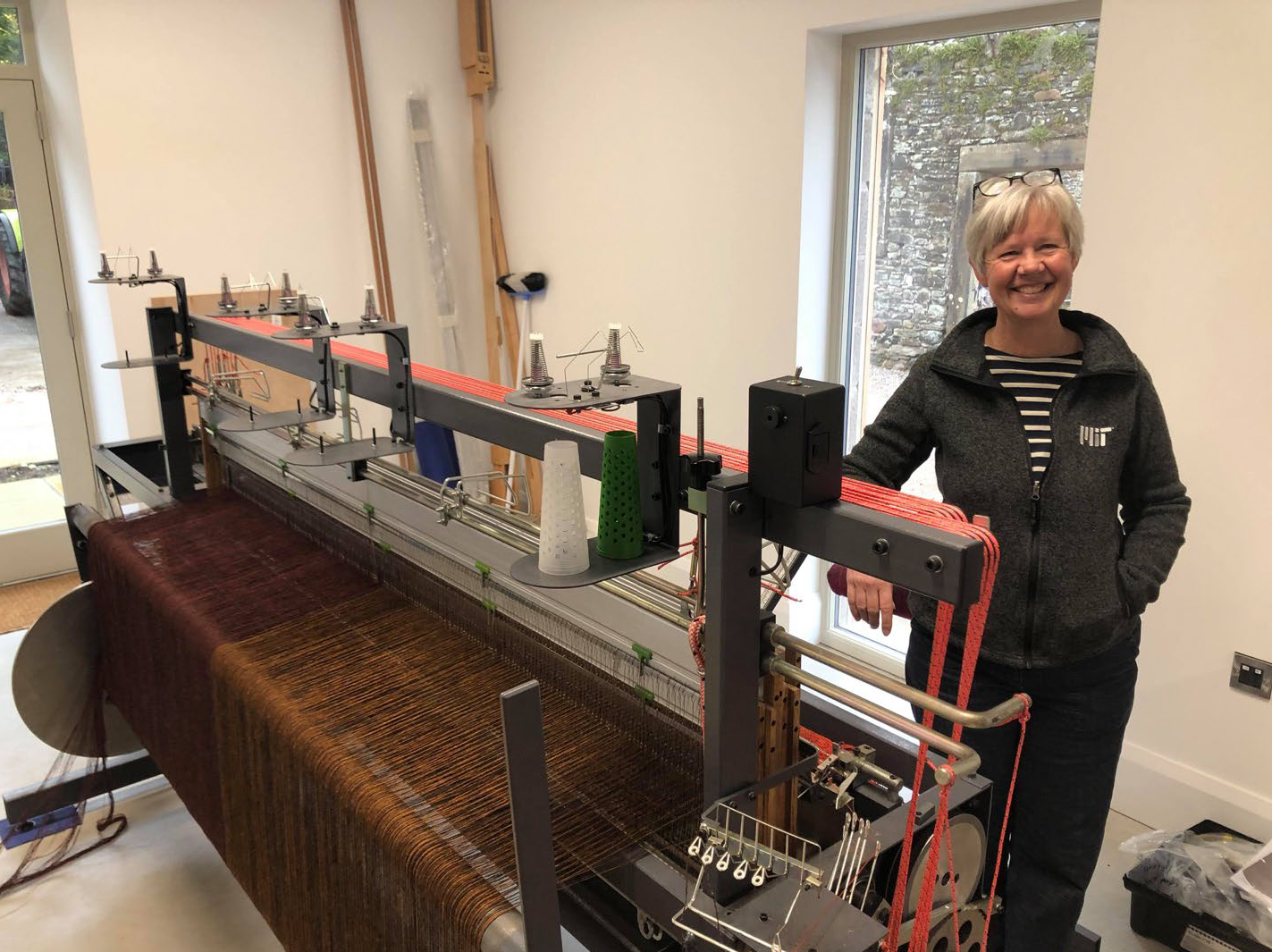
I have three looms: an American Harrisville 8-shaft Jack Loom, my first ever loom; a Canadian LeClerc 16-shaft Weavebird computer-dobby loom for more complicated patterning; and most recently a British-made 8-shaft Griffith pedal loom for small scale production weaving which is carbon-neutral. The Griffith loom has been the biggest challenge but it’s an incredible piece of engineering once you understand it!
Do you finish onsite? If not, is it convenient or what would be your ideal situation?
My mill woven pieces (scarves and blankets and some of my handwoven tweeds) are professionally finished in Galashiels; my handwoven pieces are individually finished in my home washing machine. It works for me. Hand-finishing means I learn how to control the process and achieve the desired end-result which I can feedback to the professional finishers if I want them to achieve the same handle.
Do you find that customers are becoming more interested in British wool?
Very much so. Back in 2008 it was an uphill battle to get anyone interested in working with or buying British wool. Customers really only understood wool to be merino or cashmere (not even wool!) and were leary of anything remotely scratchy. Now there’s much more interest in wool, local sourcing, sustainable and natural fibres, traceability, provenance, etc. It’s much easier now to find British wool yarn. In 2008 it was nigh on impossible to find 100% British wool yarn, especially for weaving, which is why I started to produce my own.
On a scale of 1- 10 (1 being the lowest and 10 excellent) how much do you think your business has improved in the below areas as a result of good working practices and environmental standards?
Waste Production (off-cuts, production) - 8
Plastic Pollution (packaging) - 10
Water Wastage (dyeing and finishing) - 8
Energy Consumption (shipping, machinery etc) - 8
Do you have any hero farmers or people in your supply chain you would like to highlight?
My spinner, Michael Lightowlers, helped me build a network by introducing me to scourers and weavers. Without him it would have been very hard for me to break into the textile industry as a rank outsider and a small scale business.